Have you ever wondered how much of your online activity is actually private? Every day, we browse websites, use social media, shop online, and access banking apps without thinking much about who might be tracking our data.
Internet service providers, advertisers, hackers, and even some websites can collect information about our online behavior. This is one of the main reasons why many people use a Virtual Private Network, commonly known as a VPN.
Let’s explore the five VPN features that matter most for online privacy.
Top 5 VPN Features That Matter Most for Online Privacy
A VPN helps create a secure connection between your device and the internet, making it harder for others to see what you’re doing online. However, not all VPNs offer the same level of protection. Some focus on speed, while others prioritize privacy and security. If protecting your personal information is your main goal, there are certain VPN features you should pay close attention to.
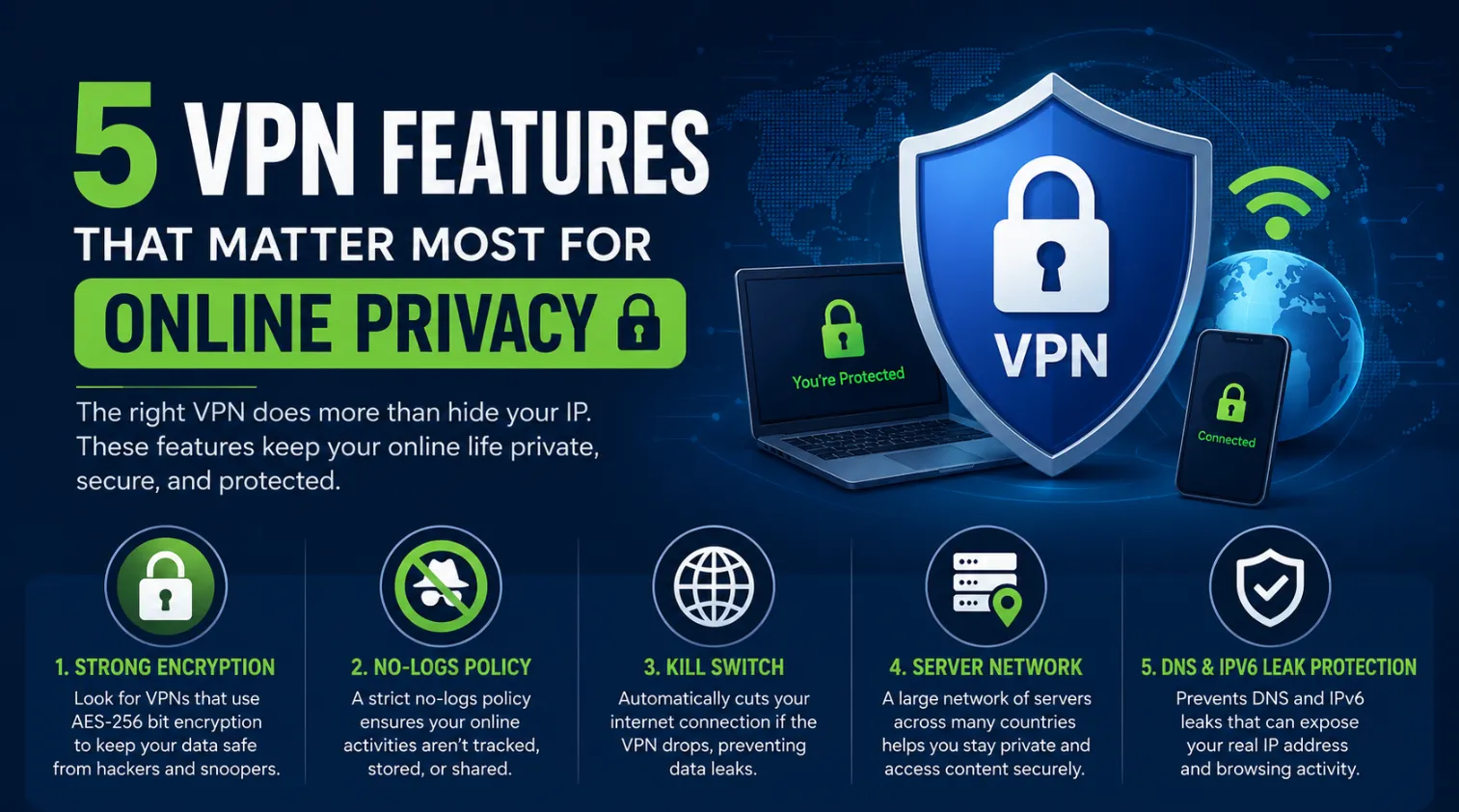
1. No-Logs Policy
One of the most important features of a privacy-focused VPN is a strict no-logs policy. When you use a VPN, all your internet traffic passes through the VPN provider’s servers. This means the provider could potentially see information about your online activity. A no-logs policy means the VPN company does not collect, store, or track details about your browsing history, connection times, IP address, or online activities.
This feature is important because even if someone requests your data, there would be little or nothing available to share. When choosing a VPN, it’s a good idea to look for providers that have had their no-logs policy independently audited. Independent audits help verify that the company is actually following its privacy promises. In simple terms, if privacy is your priority, a no-logs policy should be at the top of your checklist.
2. Strong Encryption
Encryption is what keeps your online information safe from unwanted eyes. Think of encryption as a locked box. When your data travels across the internet, encryption scrambles the information so that anyone trying to intercept it sees only unreadable code. Most reputable VPNs use advanced encryption standards to protect user data. This makes it extremely difficult for hackers, cybercriminals, or other third parties to access sensitive information.
Strong encryption becomes especially important when using public Wi-Fi networks in places like airports, coffee shops, hotels, or shopping centers. These networks are often less secure and can be targeted by attackers. A VPN with strong encryption adds an extra layer of security, helping keep your passwords, messages, and financial information protected.
3. Kill Switch Protection
A kill switch may sound technical, but it’s actually a very useful privacy feature. Normally, when you’re connected to a VPN, your internet traffic is protected through the VPN server. However, if the VPN connection unexpectedly drops, your device may automatically reconnect to the regular internet connection. This can expose your real IP address and online activity without you realizing it.
A kill switch prevents this problem by immediately disconnecting your internet access whenever the VPN connection fails. Once the VPN reconnects, your internet access is restored. This feature is especially valuable for people who prioritize privacy and want continuous protection while browsing, streaming, or working online. Without a kill switch, even a brief connection interruption could expose information you intended to keep private.
4. DNS Leak Protection
Many internet users are unfamiliar with DNS leaks, but they can create privacy risks. Whenever you visit a website, your device sends a request to a Domain Name System (DNS) server to resolve the correct website address. If these requests bypass your VPN connection, your internet service provider may still be able to see which websites you’re visiting. This situation is known as a DNS leak.
A VPN with built-in DNS leak protection ensures that all DNS requests remain inside the encrypted VPN tunnel. This helps prevent accidental exposure of your browsing activity. Even if the rest of your traffic is protected, a DNS leak can reveal valuable information about your online habits. That’s why this feature is considered essential for maintaining complete privacy. A quality VPN should automatically protect users from DNS leaks without requiring complicated settings or technical knowledge.
5. Multi-Server Locations
Privacy is not just about encryption. It also involves giving users greater control over their online identity. A VPN with a large network of server locations allows you to connect through different countries and regions. This helps mask your real IP address and makes it more difficult for websites and advertisers to track your location.
Having access to multiple servers also improves flexibility and reliability. If one server becomes crowded or unavailable, you can simply switch to another location. For privacy-conscious users, a broad server network offers more options to maintain anonymity while browsing. It also helps users access content while reducing the chances of being identified through a single fixed location.
Why Do These Features Matter?
Many VPN providers advertise fast speeds, unlimited bandwidth, and streaming support. While these features can be useful, privacy should remain the primary focus for users who want to protect their personal information. A combination of a no-logs policy, strong encryption, kill switch protection, DNS leak protection, and multiple server locations creates a solid foundation for online privacy. Together, these features help reduce tracking, protect sensitive information, and give users greater control over their digital footprint.
Pros
- ✅ Protects personal information from hackers
- ✅ Masks your real IP address to prevent tracking
- ✅ Secures your data on vulnerable public Wi-Fi networks
Cons
- ❌ Heavy encryption might slightly reduce connection speeds
- ❌ Does not make you 100% anonymous online
- ❌ Reliable privacy-focused VPNs require a paid subscription
Final Thoughts
Online privacy has become increasingly important in today’s connected world. Every time you browse the internet, pieces of your personal information can be collected, analyzed, or tracked by various organizations. A VPN can help protect your privacy, but only if it includes the right features. When comparing VPN services, focus on privacy essentials rather than marketing promises. A reliable no-logs policy, strong encryption, kill switch protection, DNS leak prevention, and a large server network can make a significant difference in keeping your online activity private. By understanding these key features, you can choose a VPN that offers stronger protection and greater peace of mind whenever you go online.
Frequently Asked Questions
01 What is the most important VPN feature for online privacy?
A strict no-logs policy is often considered the most important VPN feature. It ensures that the VPN provider does not store information about your browsing activity, connection history, or personal data, helping protect your privacy.
02 Does a VPN completely hide my online activity?
A VPN significantly improves privacy by encrypting your internet traffic and masking your IP address. However, it does not make you completely anonymous online. Safe browsing habits and strong security practices are still important.
03 Why is a VPN useful on public Wi-Fi networks?
Public Wi-Fi networks can be vulnerable to hackers and data theft. A VPN encrypts your internet connection, helping protect sensitive information such as passwords, banking details, and personal messages when using public networks.